

Design produces a great deal and resolves very little. Most objects arrive already compromised — by the tooling, by the category, by a committee's sense of what a room will tolerate. Every so often, rarely, someone works a form long enough that it stops arguing with itself. The thing becomes singular. It stops looking like a version of anything.
What happens next is the part nobody discusses. The object disappears.
It goes to a gallery, then to a fair, then to an auction, and along that route it acquires the thing the field actually trades in, which is not craft but legitimacy. Galleries and curators confer it. Design Miami confirms it. An edition of eight makes it permanent. By the time an object of genuine mastery has been properly validated, it has been placed almost entirely beyond reach — and not only by money. The scholarship on this market is blunt about the two barriers to entry: financial means, and education. You need to be able to afford it, and you need to have been taught how to know it matters.
That is the quiet violence of collectible design. The better the object, the fewer the people permitted to live with it.
An object released rather than placed
The Chrome Mirage Bookshelf, designed by Cole Walter, is exactly the kind of object that machinery exists to absorb. It is resolved, it is singular, and it would sit without complaint in an edition of eight.
It is not in a gallery. Not because it was turned down, and not because of anything decided about this piece in particular — that is not how Interior Moderna operates. The company sells direct, to whoever recognises the object — the same position it takes at IM Studio, where pieces are shown before they are built.
It is not a modest position, and the studio does not present it as one. The claim is this: an object earns its standing in the room it ends up in, not in the circuit it passed through on the way. The gate confers legitimacy. It does not create it. The form is right whether or not anyone certifies it.
Chrome goes on last
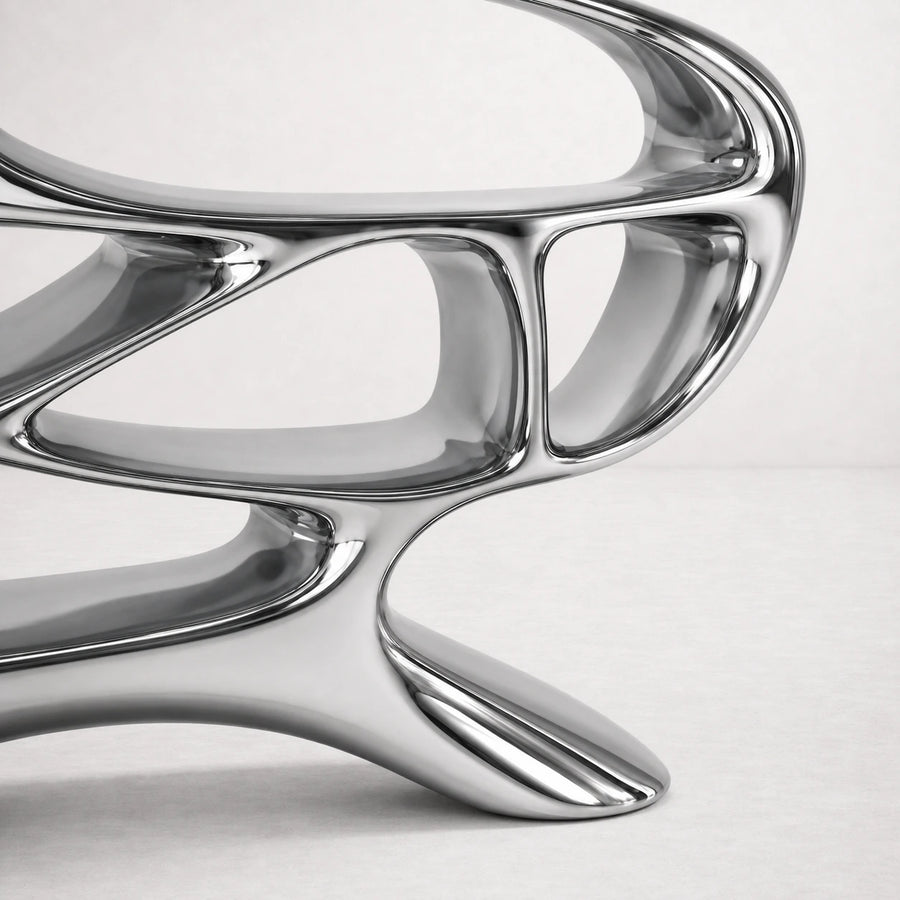
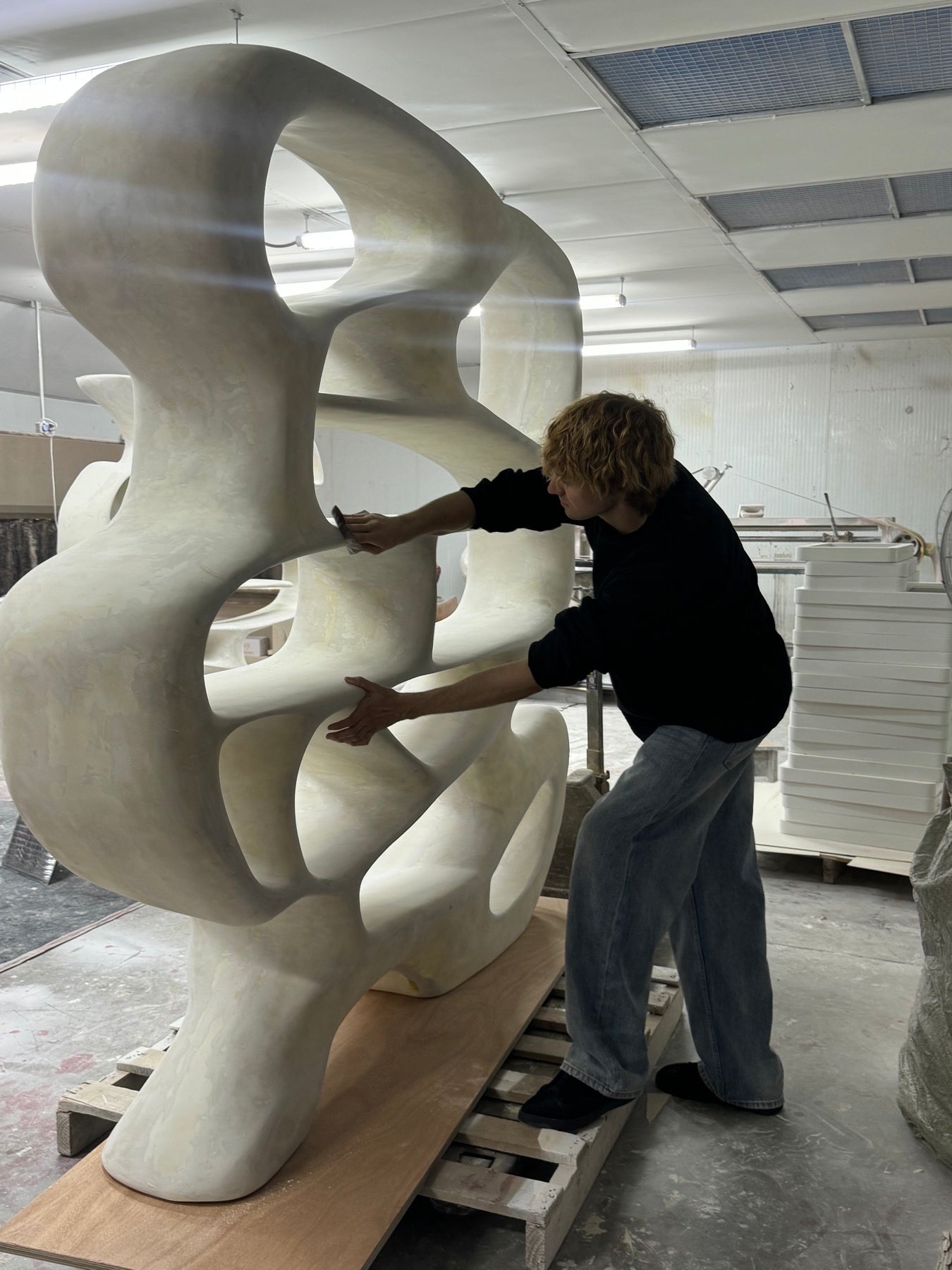
The piece is one continuous gesture. No frame, no joinery, no seam where a shelf meets an upright — the openings that hold books are not cut into the structure, they are what remains when the structure curves away from itself. It is built up in fiberglass and worked by hand until the surface reads as a single decision, and only then does it go for plating.
The order is the whole discipline. Chrome is a merciless material: it reports every flat spot and every hesitation in a curve at full brightness, and it flatters nothing. A form that is only nearly resolved will read as nearly resolved in matte and simply wrong in mirror. Everything the finished piece does — the way light travels its length, the way its openings fill with whatever room it is standing in — is decided months before any of it is reflective.
Each one is still made after it is ordered. Nothing waits in a warehouse in chrome. The same plating discipline runs through the rest of the Chrome Collection.
The standard, not the trophy
Every line has one piece that explains what the rest is trying to do. For Interior Moderna it is the Chrome Mirage — not because it is the largest thing the studio makes, but because it is the one where the intent is fully visible and there is nowhere to hide. A form worked until nothing about it could be removed. A finish that conceals none of it. And no gate between the object and the person who wants it.
That last part is the argument. The rest of the line is held to it.